
Hyderabad’s IT Corridor Gridlock: Carpooling Is the Answer the City Has Been Waiting For
📅 July 3, 2026 | Source: Times of India / Siasat Daily | Topic: Carpooling & IT Corridor
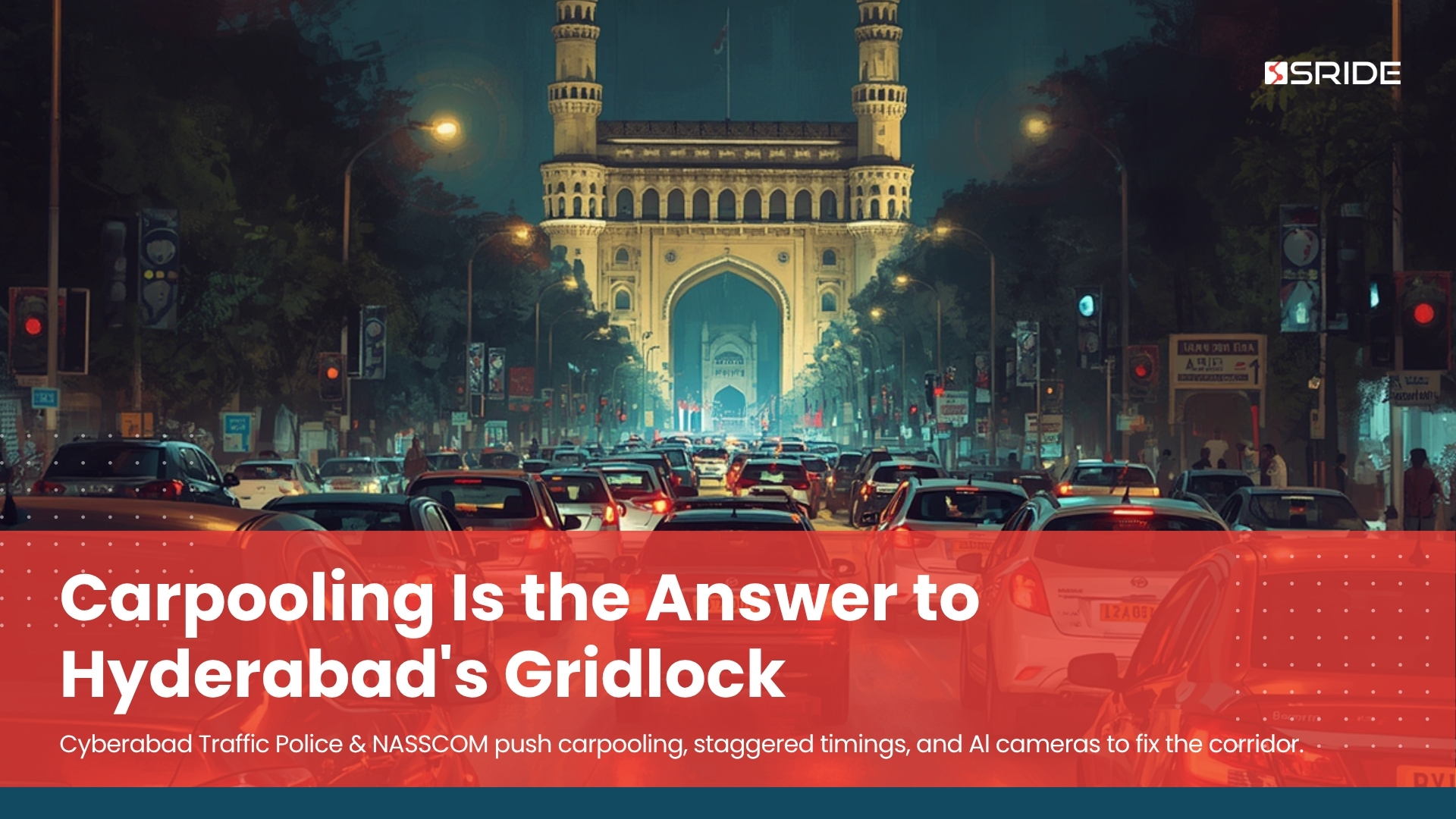
Hyderabad’s IT corridor — home to thousands of tech workers commuting daily through Gachibowli, HITEC City, and Madhapur — is buckling under gridlock that worsens every evening. The solution getting the most traction from Cyberabad Traffic Police, NASSCOM, and the Society for Cyberabad Security Council (SCSC) is carpooling. Not buses, not flyovers — carpooling. IT companies are being actively encouraged to get their employees to share rides, reduce the number of vehicles on the road, cut carbon emissions, and make the corridor liveable again. This is the moment for every Hyderabad tech worker to make the switch.
What Else Is on the Table
- →15-minute stagger rule: Offices in the corridor will adopt staggered start and end times to spread the rush-hour load.
- →100 traffic marshals: SCSC, Raheja Mind Space, and Phoenix Group are deploying trained personnel to regulate campus exits.
- →AI cameras: High-resolution AI cameras are being installed across the corridor for real-time monitoring and enforcement.
- →Mandatory regulations coming: Current measures are voluntary — but authorities have signalled that stricter rules are on the table after wider consultations.
Why Carpooling Is the Right Fix for the IT Corridor
The IT corridor has a commute problem that is uniquely well-suited to carpooling. Unlike city-wide congestion, the gridlock here is caused by a very specific pattern: thousands of workers heading to the same cluster of campuses, at the same time, five days a week. That predictability is exactly what makes carpooling so powerful in this context.
According to Cyberabad Traffic Police, the volume of private vehicles peaks sharply in the evening hours when IT workers leave offices simultaneously — and rain makes it dramatically worse. A shift in behaviour where even 30% of commuters share rides would remove thousands of vehicles from the corridor each day.
“The traffic volume is high in the evening hours when most of the IT workers leave offices. The rain aggravates the situation.”
— D Joel Davis, IPS, Joint Commissioner of Traffic Police, Cyberabad
Who Is Driving This Change
The push for carpooling is coming from a powerful coalition. The Society for Cyberabad Security Council (SCSC), NASSCOM, and the Cyberabad Traffic Police jointly chaired a cluster meeting with IT and ITES companies specifically to make carpooling a structured, company-level commitment — not just a personal choice.
Companies like Raheja Mind Space and Phoenix Group have already stepped up — committing to deploy trained traffic marshals and adopt internal carpooling programmes. The message from authorities is clear: voluntary action now, or mandatory regulation later.
What Carpooling Actually Solves
- ✓Fewer vehicles on road: Each shared ride removes one car from the corridor — multiply that by thousands of daily IT commuters and the impact is immediate.
- ✓Lower carbon emissions: Less fuel burned per commuter means a measurable drop in the corridor’s daily carbon output.
- ✓Cost savings for commuters: Splitting fuel and toll costs can save a Hyderabad IT professional ₹3,000–₹5,000 per month.
- ✓Reduced parking pressure: Fewer cars means fewer vehicles hunting for parking — easing another major pain point on campus peripheries.
- ✓Sustainable commuting culture: Once adopted at scale, carpooling becomes self-reinforcing — the more people do it, the easier it gets.
Got thoughts on this? We’d love to hear from you.
Drop your comments below or write to us — whether you commute on the IT corridor or want to see carpooling pushed further across Hyderabad.
Start carpooling with sRide
Find verified co-passengers on your exact route. Download the app and share your first ride.


📅 July 3, 2026 — Source: Times of India, Hyderabad — “15-minute stagger, carpooling revival, AI cameras: How Hyderabad’s plan to fix IT corridor gridlock” (2026) | Siasat Daily